
AI, Copyright, and the Future of Creativity: A Conversation with Dr. Dino Gliha
Interview, 24 November 2025
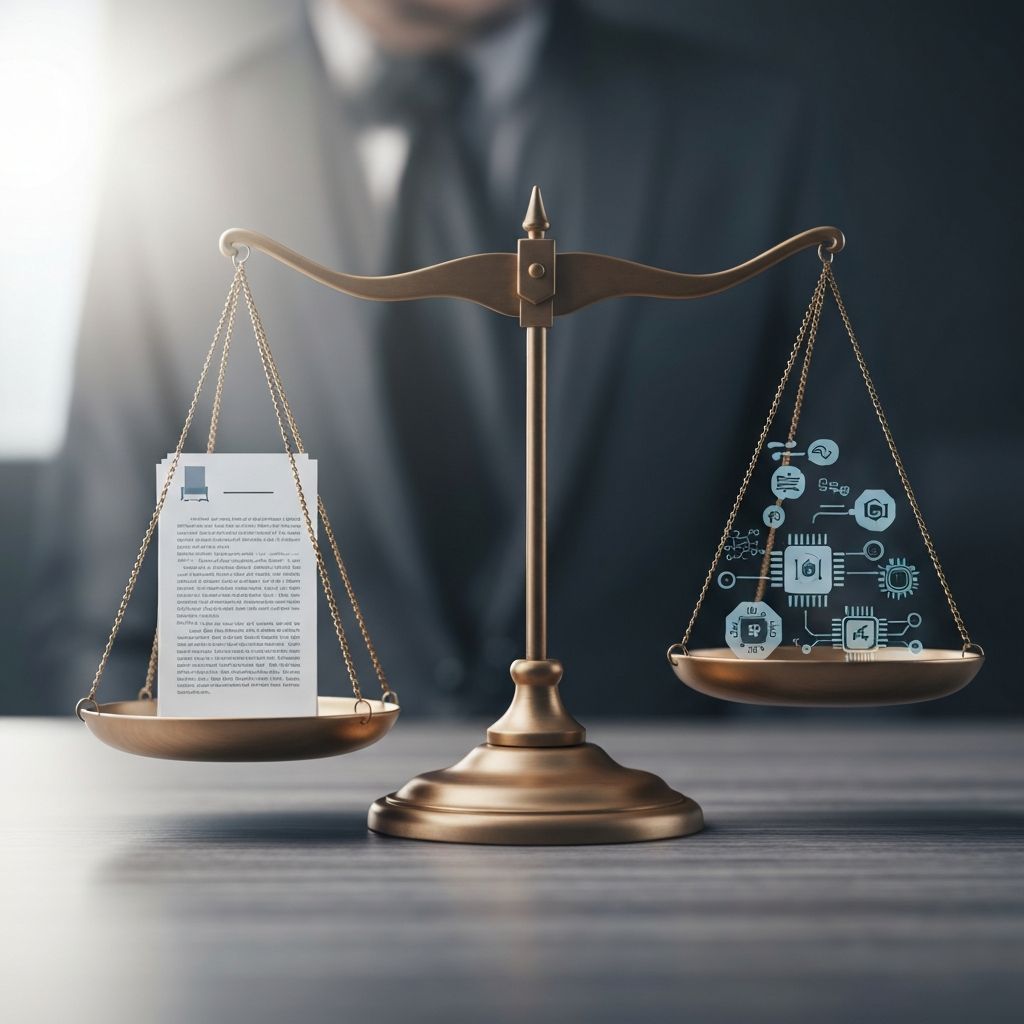
At FanePath AI, we help brands understand how they appear across generative engines like ChatGPT and Google Gemini, and what that visibility means for their creativity, reputation, and strategy in the age of AI.
But as AI grows, it raises a crucial question at the crossroads of law and creativity: who owns the data that teaches machines to create?
To explore this, Lucile, FanePath AI CEO, speaks with Dr. Dino Gliha, an AI strategy consultant and legal scholar. Together, they discuss how regulation is evolving and how AI can progress without losing its human touch.
Building a Career at the Intersection of Law and Technology
Lucile: You've built an impressive career at the intersection of law, technology, and innovation. Could you tell me a bit about how you came to focus on the legal challenges of AI?
Dino: Thank you, Lucile, and congratulations on your venture. I truly believe there's a growing need to help brands understand what's happening behind AI systems and how they feature on LLMs.
I started out as a lawyer but was always drawn to mathematics and technology. Early on, I realized that traditional law wasn't for me. Through intellectual property, I found a fascinating intersection where law, science, and innovation meet.
Today, I work as an AI strategy consultant, patent representative, and business-legal advisor. I hold a Doctorate in Copyright and Competition Law from the University of Zagreb and completed advanced AI business studies at Oxford.
I now lead a law and consulting firm that supports startups and innovative companies on AI readiness, intellectual property, and regulatory compliance. Alongside consulting, I'm active in research, public speaking, and policy work, particularly around the legal and ethical dimensions of AI. After nearly a decade in the field, I've found a strong balance between law, technology, and business…and our time at Oxford was a big part of that journey.
Exploring Copyright and Competition in the EU
Lucile: You recently published a book related to this field.
Dino: Yes, my book is titled "The Copyright–Competition Interaction within the EU" and was published by Springer in 2025. The project took about four years and became a turning point in my career. The book reflects both my academic and practical experience.
It explores how copyright law intersects with competition law in the European Union, a critical area for understanding how innovation is regulated.
That research naturally led me toward artificial intelligence and machine learning. Around 2018, even before tools like ChatGPT became more widely accessible, I began focusing on the evolving relationship between AI and copyright law. My current research, and much of my consulting work, centres on three key areas:
- Input issues – the data used to train AI models.
- Model issues – ownership and protection of the models themselves.
- Output issues – the legal status and authorship of AI-generated content.
Input Issues: Copyright and AI Training Data
Lucile: Let's focus on the input aspect: the data used to train AI models, especially large language models. From a legal standpoint, what are the main copyright concerns right now, and what makes this issue so complex?
Dino: AI models rely entirely on data. Without vast datasets, large models like LLMs wouldn't exist. However, one of the biggest challenges is the availability of lawful training data.
Many AI systems were trained on everything available online. The 'internet'. but "available" doesn't mean "legally usable." Just because you can access an image or text online doesn't mean you can reproduce or commercialize it.
Training AI involves reproducing data, which under copyright law is considered an act of reproduction. But since models ingest billions of data points, it's nearly impossible to trace which copyrighted works were used or who should be compensated.
Some major players have started negotiating licensing agreements with AI providers (for instance, News Corp's agreement with OpenAI and Le Monde's partnership allowing its content to be used for AI training), but the details are rarely public. The real problem lies with small creators who don't get paid, even though they produce much of the creative material used to train AI models.
Different Legal Cultures: EU vs. US Approaches
Lucile: Looking at this from a practical perspective (especially around licensing agreements with AI providers) the EU and the US seem to approach AI and copyright very differently. How do their legal frameworks diverge?
Dino: Yes, they differ significantly. The US follows the common law tradition, while most of Europe follows civil law.
In the EU, copyright is seen as an absolute right—a natural extension of the author's personality. Any limitations must be explicitly written into the law. But research shows that this exception doesn't legally cover AI model training.
In contrast, the US system emphasizes flexibility through doctrines like fair use, which allows certain unlicensed uses if they meet specific criteria, such as being transformative or non-commercial. The US approach focuses more on commercial impact than on moral rights, whereas Europe emphasizes the author's personal connection to their work.
These foundational differences mean that what's permissible in one jurisdiction might be illegal in another.
Still, both sides are now facing similar questions: Who owns the model? Who owns the data? And who owns the output? Even defining the "model" is complex—algorithms and source code may be protected as literary works, but trained models themselves occupy a grey zone.
Toward a Fairer AI Ecosystem
Lucile: So, looking forward, how do you see copyright law evolving to address these challenges? What could be a fair or realistic solution?
Dino: If we focus only on the Input stage (the training data used to build LLMs), the key is finding a way to compensate creators whose work is used in training. One realistic path is collective licensing, similar to how music royalties are managed today. Another idea is blockchain-based tracking, allowing creators to monitor how their work is used and automatically receive payment through collective management systems.
Users also need to be cautious: every AI provider has different terms and conditions. Some allow full commercial use; others restrict it to personal use. Always read the small print—especially if you're building a business around AI outputs.
Balancing Technology and Humanity
Lucile: Yes, data governance is crucial! And at FanePath AI, we take it very seriously. I've been through that process myself; it's challenging but essential.
If we focus again on the input issue, could we realistically separate it from the others and find a standalone solution?
Dino: Not easily. It's almost impossible to trace every piece of training data, especially since models evolve faster than the tools we have to audit them.
Ideally, AI providers would fairly compensate creators, but for now, the systems to make that happen don't exist. I believe current copyright laws are strong enough—they just need clearer interpretation and enforcement in the context of AI.
Collective management and blockchain could both play important roles. But we need cross-sector collaboration—lawyers, technologists, economists, and policymakers working together—to create a system that's both fair and sustainable.
"We don't want a world where everything sounds the same because it was generated by machines. AI should augment human creativity, not replace it."
Lucile: I completely agree. It's not just a legal or technical matter, it's deeply human. We need to ensure that creators can still live from their work. Otherwise, we risk moving toward a purely synthetic society.
Dino: Exactly. If we can find the right balance (protecting creators while fostering innovation) we'll strengthen both our culture and our society.
Navigate the AI Landscape with Confidence
As AI continues to reshape creativity, law, and business, understanding how your brand appears in generative engines is more critical than ever. FanePath AI helps you navigate this complex landscape with clarity and strategic insight.